SOPA Strike

Saturday, February 18, 2012

Notes on Marx

This past week, I gave a short presentation on Marx during my group's presentation on the 19th century. I really struggled with this one, because there is so much to say about Marx and the results of his ideas. However, a blog post is a great place to follow up on all the things I couldn't say. Here are some of my notes on Marx: 


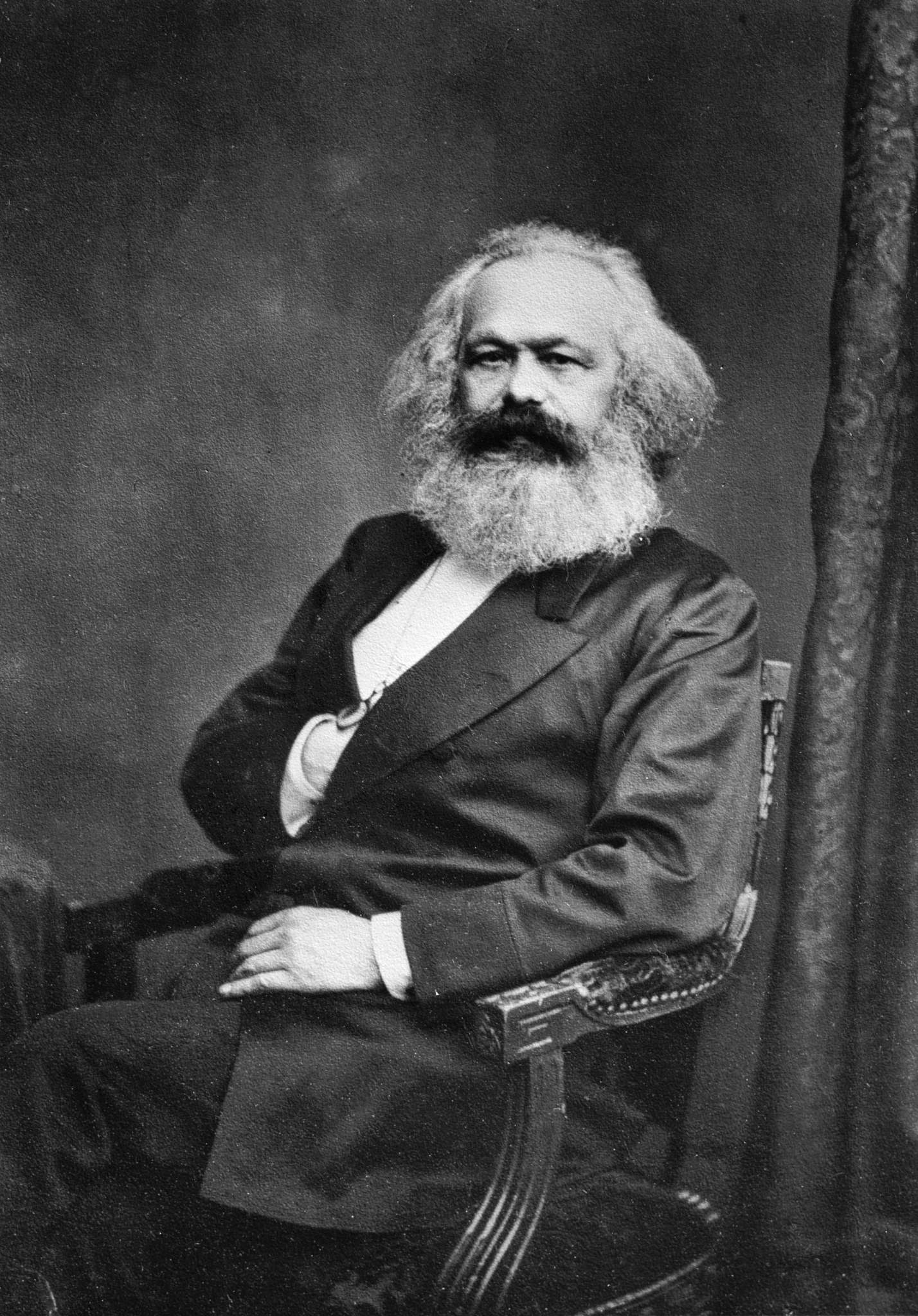
Karl Marx was born into Germany's middle class, though he himself was on the relatively wealthy end. He was married and have several children, though not all of them made it to adulthood. Only three of his children with his wife, and his illegitimate son with the maid, made it to adulthood. His illegitimate son was raised by foster parents out of the home to avoid scandal, but the maid stayed with the family.


Marx started out at the University of Bonn, but then transferred to the University of Berlin because his father wanted him to take his studies more seriously. There, Marx was heavily influenced by the ideology of the recently deceased Berlin professor and philosopher G.W.F Hegel. Hegel was popular for his philosophy of the Mind, in which the Mind is kind of everything, and we are all apart of this universal Mind. Marx spent time with the Young Hegelians, but eventually decided he needed to finish his PhD and move on. He submitted his thesis not to the University of Berlin, but to the University of Jena, which was said to be somewhat of a degree mill of the the time.


Marx moved around various countries, getting kicked out by the Prussians who ruled Germany at the time because of his socialist views on politics that were very anti-Prussian. He eventually got kicked out of France and later Belgium, and spent the latter half of his life in England. He collaborated extensively with Friedrich Engels, and constantly bummed off him. Marx was relatively poor in the first half of his life because of his political views and activities, and his family really only got along because of the charity of Engels. Later, when Marx became relatively affluent due to several inheritences and moved to an eight-bedroom home in London, he still bummed money off of Engels.
One of Marx's earlier and well-known written works is the Theses on Feuerbach. This was made famous for the quote: “the philosophers have only interpreted the world, the point is to change it.” In it, Marx put forth his idea of historical materialism: the world is changed not by ideas but by actual, physical, material activity and practice.

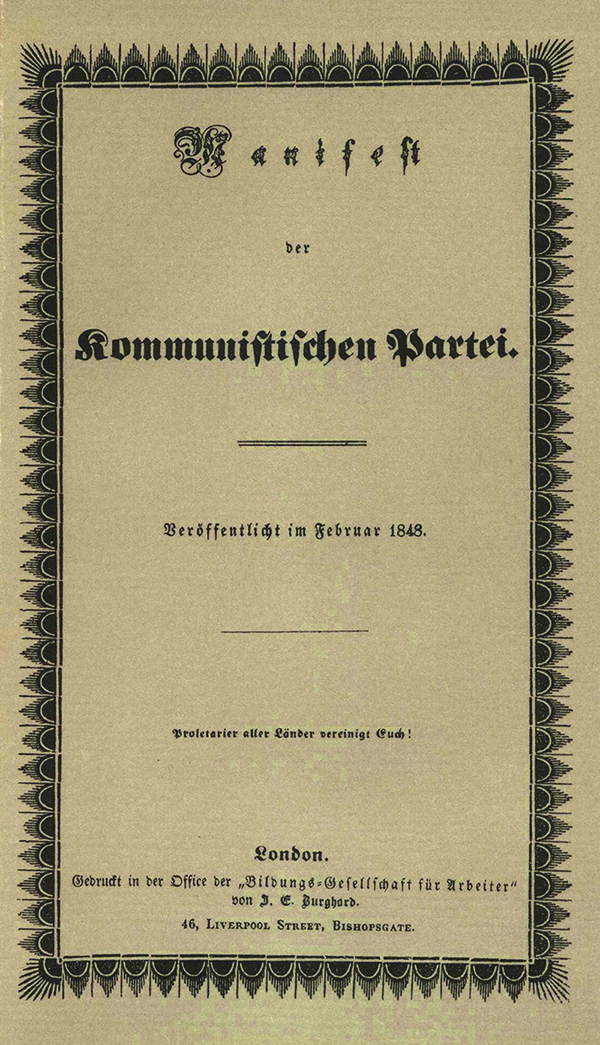
Marx's most famous work is the Communist Manifesto, a political pamphlet both he and Engels wrote. In the opening lines of the pamphlet, the principle of Marxism is presented: “The history of all hitherto existing society is the history of class struggles.” The Communist Manifesto examined the struggle between the bourgeoisie (wealthy middle class) and the proletariat (industrial working class). Its main purpose was to establish why the Communist League was in the best interest of the proletariat, which was the political group Marx (and Engels) was heavily influencing.

Marx was very critical of the socio-economic system of the time: capitalism. He called it the dictatorship of the bourgeoisie, run by the wealthy classes purely for their own benefit. Marx believed that like previous socio-economic systems it would produce internal struggles and collapse, and be replaced by socialism. In a socialist society, the working class would govern in a workers’ democracy. Socialism, in turn, would be replaced by a stateless, classless society called communism. He believed both were inevitable, but fought for the actual implementation of the former, calling upon the underprivileged and social theorists to perform and organized revolution to topple capitalism.

In a large multi-part work called the Capital, Marx
analyzed the capital system in great depth, noting its various stages and characteristics and put forth theories why it must inevitably fail. I obviously have not read his work on capitalism, but thinking of the capital system at the time, I wonder if Marx was right that it would have failed as it stood. However, I don't think capitalism then and capitalism today is the same. Instead, the system evolved and hopefully a great deal of its flaws and weaknesses of the time have been overcome.

Marx was characterized as one of the most influential thinkers of his time. I don't believe he was the first one to think of socialism or communism, but rather he put forth strong ideas about both that many people adopted as a basis for later forms of socialism and communism. Socialist governments building on Marxist theories arrived in the 20th century: the Soviet Union and the People’s Republic of China. These governments built on Marxist principles and developed into Leninism, Stalinism, Trotskyism, and Maoism

To me, Marx was very contradictory. His Communist Manifesto calls for the abolition of inheritances, yet he clearly needed and enjoyed his several inheritances. It calls for the working class to work together, etc, but he seemed kind of a bum if you ask me, always bumming off Engels. He defended against the idea that communism supports free love, yet fathered a son with the house maid. I barely skimmed the surface of Marx's life here, and lifetimes could be spent discussing his theories and the impact they had on society, and whether they were for good or bad. I am am from the United States, which is a capitalist society, and it is somehow driven into our minds growing up that capitalism is good and socialism and communism is bad. Our history books pretty clearly pain this picture, painting historical figures like Lenin, Stalin, Mao, and Castro as corrupt dictators who abused their power. And from our perspective in the USA, it certainly looks that way. But have you ever wondered what it would have been like to grow up in a communist country, and what their textbooks have to say about us?


Saturday, February 11, 2012

Presentations Done Right.

In class we've talked a lot about death by Powerpoint. Some people have decided to shun slides altogether, while others may have felt that a Prezi is okay because it's not Powerpoint. Katherine Carlsen actually pointed us to an awesome TED talk on Dance vs. Powerpoint. My solution to the Powerpoint problem? Keynote. And some great tips I picked up as an intern at Apple.

For those who don't know, Keynote is Apple's answer to Powerpoint. It's actually really slick, and it's way easy to make really good-looking presentations. My favorite tool in Keynote is the Instant Alpha tool. It lets you obliterate a color in an image you put in your presentation. Ever downloaded some graphic that looked good on Google's white image results page, only to drop it into Powerpoint and have your graphic surrounded by a big ugly white square on your dark background? With instant alpha, zap away that white square and have an awesome graphic looking like it was made for your presentation.

But really, this isn't a rant about how awesome Keynote is and how Powerpoint is blech. The first time I used Keynote, I actually brought a lot of bad habits with me into my slide deck and made an embarrassing presentation. The truth is, slide presentations suck because people make terrible presentations, not because the software they're using sucks. You can make a great presentation in Keynote, Prezi, and even Powerpoint. And you can make terrible ones in all three, too. While I interned at Apple, my internship climaxed with a presentation I gave before the CIO of Apple, Niall O'Connar. I prepared for and practiced that presentation for weeks, and my presentation got slashed to bits by several different managers as I refined it along the way. I thought I knew how to make and give presentations before that summer, but how wrong I was. In the end, here are some simple tips I picked up on making presentations:
  1. Pictures are a 1,000 words. 
  2. 3-5 word sentences. 
  3. Say what's on your slides.
  4. Delete unspoken text from slides.
  5. Make your presentation look good.
  6. Use a consistent font.
  7. Don't nauseate your audience.
All of these points look like no-brainers, and they should be. So why is it that every presentation you've ever seen that sucked not followed these? If I were giving a presentation, I could easily insert this list into my slides. I'd probably have it split up onto two slides. And then as I gave my presentation, I'd elaborate as follows:

Use more pictures. Google image search is not that hard. Don't put ugly, pixelated pictures in there, and don't put funny joke images in there unless absolutely everyone is going to get it or you're going to explain the joke so everyone laughs (i.e. not in a lame, humor-killing way). Take the time to clean up images. This is why Keynote's Instant Alpha tool rocks. Lame white squares with your graphic in the middle look lame, and if your presentation looks like sucks and only half-effort was put in, chances are it will suck because you only put in half the effort you should have.

Don't pollute your audience's eyes with the amount of text you put on each slide. Sentences should be as short and crisp as possible. 3-5 words it the ideal target. Make definitive statements, and each statement with a period. That includes each point in a list where applicable.

Say everything that is on your slides. If you have text on your slide you're not using in the audible form of your presentation, it shouldn't be on your slide. This is very contrary to the traditional Powerpoint model where people put a ton of text with every nitty-gritty detail on every slide, and only say 10% of what their slides say. If you do this, your audience will not be paying attention to you while you speak. They'll be squinting and trying to read the bajillion words on your slides, and trying to decipher their meaning. Don't do it. Just don't. Copy/paste those right now into your presenter notes, and then write what you're really trying to say in short, concise statements.

Again, your slides is not a place for your to paste your 50-page thesis. Delete everything you're not going to say, and then delete 80% more of what's left. Only have the most critical, plain, and necessary statements in your presentation. Your audience can go read your thesis (or blog post) later.

Make it look good. Your presentation shouldn't look like a 5th grader made it. There are a lot of good themes for slide presentations out there, so use them. Keynote's built-in themes are just plain hot. Unfortunately, that's an entirely subjective statement (unlike anything else in this post), and Keynote is only for Mac and iPad. But there are some good Powerpoint themes. You just have to look a little harder.

I messed up on this one a few times. I mixed fonts from the presentation theme and external fonts. It looks ugly, and people will notice. Use consistent fonts throughout the entire presentation. Details matter.

Don't make me want to throw up as I watch your presentation. That applies to both looks and transitions. This is where I feel Prezi's aren't always so good. They try to be dynamic and hip, and I admit Prezi is a pretty cool piece of software, but when you're hunting for that slide that says what you wanted to say next, and you switch more than one slide, Dr. Zappala is suffering from his vertigo. And I'm getting sick. So just practice your presentation, know your slide order, and be aware of and avoid nauseating transitions.

So there you have it. My excruciating long blog post about presentations. I wish I could have given you the Keynote version. It would have been much less painless. But hopefully now you've remembered what exactly makes you scared of Powerpoints, and how you can fix it. Slide presentations aren't bad. They can be used as a very effective tool, and help your audience visualize what you're presenting. However, they can be done horribly wrong and have us shouting "Death By Powerpoint!" in an instant. 


UPDATE: Here's a link to the Keynote I gave on Thursday about Wise Crowds. You don't to have a Mac to view it; you can check it out in your web browser.

Revolutions.


This week we talked a lot about the revolutions of the 18th century, namely the American, French, and Industrial revolutions. Our revolutions did a lot to talk about people and the way they participated in these revolutions. Revolutions have always been so interesting to me. How do revolutions get enough people to participate that it reaches a tipping point and the revolution is successful? How do people individually reach the point of decision to do something, to join the cause, potentially sacrificing everything for the unknown? And how do the individual decisions of so many sum up to the movement as a whole? How do critical key players and moments factor in to each revolution? Every time I study a revolution, tons of questions like these come to mind, with the most critical reflection being: what would I have done I had been there?

With the talks of these three revolutions, and our emphasis on participation, I was surprised we didn't talk about more modern revolutions. The most famous one of these of late was the Egyptian revolution, which is technically still going on. The most famous character in this revolution has been Wael Ghonin, a Google executive who moonlighted as the revolution's leader. He used Facebook and Twitter to organize the rebellion that eventually led to the end of a 30 year regime and Egyptian President Hosni Mubarak stepping down. Ghonin told reporters: "If you want a free society give them Internet access," coining the phrase Revolution 2.0.


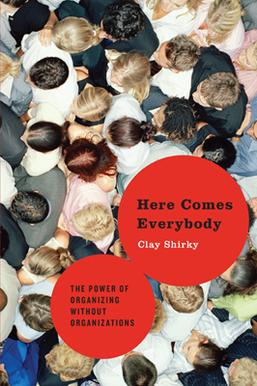
Ghonin is not the first person to use social media in recent years to organize a rebellion, and he certainly won't be the last. Clay Shirky's Here Comes Everybody talks extnsively about the rise of citizen journalism, and the voice given to the masses by technology. Syria actually banned the iPhone as a way of trying to suppress reports of its crackdown on protesters going viral on the Internet. Wikipedia links the term "Twitter Revolution" to a variety of revolutions where Twitter and other social media tools were utilized.

We study revolutions, like they are a thing of the past, but revolutions are alive and happening in our day. And people are using the Internet and social media to do them. Since the power and ability to participate has exponentially increased with these tools, so have revolutions. Its not the American Revolution one decade, and the French another, but several revolutions in a few years all taking place because people can finally make themselves heard like never before.

Are You an Open Source Bigot?

As we have talked in class about openness, and especially as we have focused on the merits of open source movements and relating them to things like open government and open education, I have often reflected on the following article by Josh Coates: Are You an Open Source Bigot? Josh Coates is the founder and former-CEO of Mozy, and is currently working as the CEO of Instructure, an open source LMS competitor to Blackboard. I actually work at Instructure as an iOS Developer, and wish we used Instructure's Canvas in our class :/ But that's not the point of this post.

In the world of software, there are two main camps: open vs. proprietary. Apple, Microsoft, and Adobe are some of the big names in the proprietary software camp, while the biggest names in open source would have to be Linux and Apache. It's easy to hate the big guys raking in the money, and toute the merits of open source products because they usually come with a small to no pricetag, but the truth is they all have their merits. To simply cast out one camp or the other is foolish.

Josh talks about how he has interviewed countless software engineers, and one of his favorite questions is about which is best: FreeBSD, Windows, Solaris, or Linux? The answer according to Josh is that they all more or less equally suck. And he's absolutely right. In the end, every platform out there has its merits and its downfalls. Both proprietary and open source are right. So when we advocate only one right answer, and refuse to acknowledge the merits of others, we risk serious bigotry.

Josh's article is mostly directed towards the open source camp, which is why I think it is so relevant to our class. We are trying to think different, and since most of us grew up conforming to the society around us including the proprietary or closed methods of doing things, our immediate reaction to the call to think different is to cry for open source, open government, open education, open everything! In championing our various open causes, we look down on anything closed or proprietary, directly associating it with the man and all things evil. But this kind of exclusive thinking is dangerous. It's the kind of thing that has gotten a lot of people in trouble in history. As always, moderation is the best answer, taking in all the different camps into consideration and forming the best combination. When championing a cause for openness, remember the points Josh makes in his article and reflect: am I an open source bigot?

As we move forward in class trying to think different, remember that one of the greatest champions of that slogan is also one of the greatest advocates of proprietary software: Apple.

Saturday, February 4, 2012

Open Crowd Sourcing Fail.


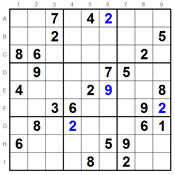
Well, Thursday's exercise in mass Sudoku playing turned out to be an epic fail. I was guilty of eagerly plowing along with several other classmates on a collaborative sudoku puzzle, competing with the sole player who was unlucky enough to be the butt of our competitive egos. We eagerly announced our completion of the puzzle only a few minutes later... and realized it was entirely wrong. Somehow the puzzle had gotten messed up beyond repair, and eventually I and the rest of my classmates abandoned the puzzle.

The activity was meant to be a demonstration of the power of open collaboration. It was class crowd sourcing, and for some reason it didn't work. Why did it fail? We were trying to hard to beat our sole adversary, and we trusted each other too much. It backfired. We didn't reach the solution, we were demotivated, and we never did finish the puzzle.

I have recently been reading the book Wisdom of the Crowds, by James Surowiecki. It's a great book that counters advocates the idea that the wisdom of the group is often as good as if not better than the smartest individual. It seems that our experience in class would counter his argument, but he gave four conditions that characterize wise crowds:

  1. Diversity of opinion. Each person should have some private information, even if it's just an eccentric interpretation of the known facts.
  2. Independence. Each person's opinions are not determined by the opinions of those around them.
  3. Decentralization. People are able to specialize and draw on local knowledge.
  4. Aggregation. Some mechanism exists for turning private judgements into a collective decision.
After looking at his points, it is clear that our class did not meet the requirements of a wise crowd, even if we met some of them. We did have diversity of opinion in that each person was working on the puzzle from a different perspective, and were diversified in angle attack. For example, I could be looking to complete the third column while someone else could be working on completing all the 2's. We kind of decentralized in that sense as well, each person working from their own angle. The puzzle itself was an aggregation of sorts, combining all of our solutions into the complete solution. However, we did not have independence. The aggregation did not come at the end of our puzzle doing, but rather as we went along. Thus each person's decisions directly affected the decisions of others. Somebody putting an 8 in one row might lead another to assume the spot for a 1. Somewhere, someone made an assumption based off of someone's incorrect placement of a number, creating a domino affect on the other puzzle doers and leading to our faulty solution. 

Next time, if we make sure no one plays base off of a hunch (an opinion) about the placement of a number, and guarantee that no one makes a mistake in number placement, only placing numbers based on absolute certainty, we can have a better chance of solving the puzzle. Of course, assuming the perfection of each and every player is silly, so in the end there's no guarantee on the outcome of the puzzle with a group so large :)

But crowd wisdom is a real thing. Surowiecki has already given countless examples of this in the book, like the market placing correct blame on the Thiokol company a half hour after the space shuttle Challenger blew up, even though the finding of the faulty Thiokol O-rings didn't occur until days later. Or how about the collective result of the opinions of a wide variety of men on the location of the lost submarine Scorpion in 1968: they were only 220 yards off. I am far from finishing Surowiecki's book, but so far it has been an engaging read, and I look forward to gaining more insight on the wisdom of the crowd. 

Did everyone forget about Japan?

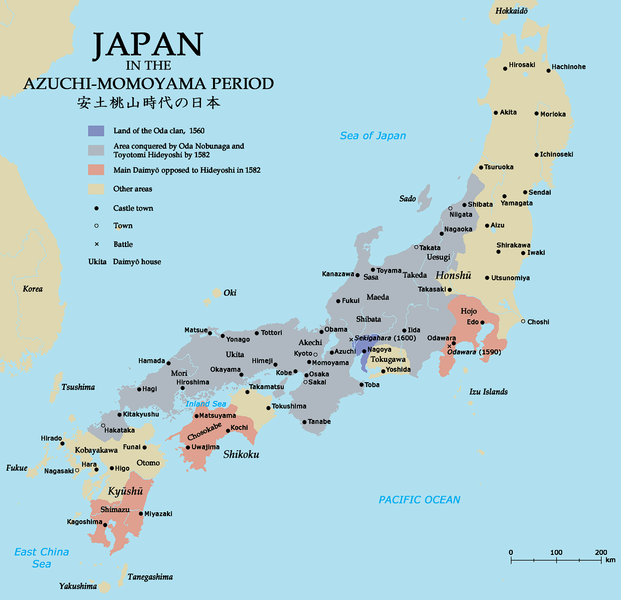
As we talk about the various historical periods in class, it seems we often gravitate towards a focus on Europe and America. But obviously the world is bigger than two continents. For me, I like to hear about what was happening in Asia. I lived on the island of Hokkaido, which is the northernmost island of Japan (you can barely see the southern tip in the image to the right) from 2008-2010. Interestingly, Hokkaido was inhabited mainly by natives called the Ainu until quite recently. Japanese people didn't start moving to Hokkaido until the last few hundred years (mostly the 1800's), assimilating or wiping out the Ainu in a process similar to what happened to Native Americans.

In the 16th century, Japan was nearing the end of its Warring States period, which had lasted for a hundred years. Up to this point, Japan was actually split up into several feudal states, and it was these many feudal states that had been fighting ever since the Ashikaga shogunate collapsed. However, by the end of the 16th century, Hideyoshi had risen from the ranks of a foot soldier to succeed his feudal lord and actually unify Japan.

Another important happening in the 16th century for Japan was contact from traders and Jesuit missionaries from Portugal. This marked the first direct contact and commercial exchange with Japan and the West, and that relationship has only continued to grow. As of 2011, Japan's economy was the third largest in the world, after the US and China.

As we continue to study the historical periods in our class, its important not to forget the events happening in other parts fo the world. Technology has made the world smaller and more intertwined, and Asia has long since established its ground as a critical player in the digital economy. With the impact of Nintendo, Sony, and the many other Japanese electronics companies, Japan is a country we can't forget in our modern age.

Beethoven vs. Lil Wayne

In class Thursday, we were challenged with an interesting question regarding music in the 17th century and music in our age: "Has incorporating technology enhanced music or taken away value?" The answer is yes. It has done both. It seems like music was such a center of culture in the 17th century, though by saying that we mostly mean in terms of Europe. America was still a bunch of colonists trying to survive, and other parts of the world were facing their own problems. All the famous composers to whom the presenting group gave tribute with shout-outs on the violin were from Europe. The world, of course, is much larger than Europe.

This is the greatest thing I feel technology has done for music in our day. It allows us to appreciate music from all over the world. I am not so bold as to claim I am musically cultured. But thanks to technology I can easily listen to music from Brazil, Japan, Africa, or anywhere else I choose. Music still is so much a center of our culture, but by culture we no longer refer to just European culture. We refer to the culture of the world.
And yet, technology may have hurt music as well. I don't believe people can compare the works of Bethoven or Bach to someone like Little Wayne. That's like comparing apples to rotten prunes. It's very clear which one has more class and culture. Or how about Rebecca Black? Regardless of her intentions, the fact is that technology allowed for some girl of relatively little talent to go viral and make a lot of money (no matter what happened to the money in the end). Could something like that have happened in the 17th century? I don't think so. But in the end that same technology gives hope to the hundreds of Indie bands out there hoping for a lucky break. And for that I'm grateful. Technology becomes that great enabler that gives the hidden talent a chance to shine.